
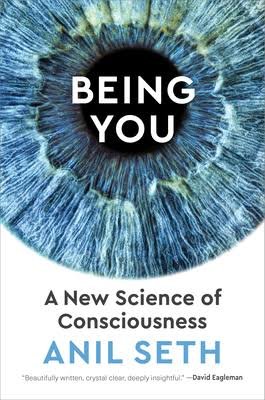
Anil Seth’s Being You is compelling because it makes ordinary experience feel constructed. Perception is active. The brain is constantly generating models and updating them against sensory information. The self feels immediate, yet it depends on biological processes that can be studied.
Readers who want science fiction about consciousness after an Anil Seth book are therefore looking for more than stories about uploaded minds. The best matches ask what perception is, what makes a self, how bodies shape experience, and whether intelligence and consciousness are the same thing.
Blindsight by Peter Watts
Blindsight is the obvious first recommendation. Peter Watts asks whether consciousness is necessary for intelligence.
That turns an alien encounter into a direct challenge to human self-importance. If a system can perceive, predict, communicate, and act intelligently without anything like our inner experience, what exactly is consciousness doing for us?
This is philosophical science fiction with teeth because the argument affects survival. Consciousness is not a seminar topic. It may be an evolutionary cost.
Solaris by Stanislaw Lem
Solaris approaches the problem from the other direction. The ocean on Solaris appears to be intelligent, but humans cannot determine what kind of mental life it has, if any category available to them even fits.
The story keeps exposing the human habit of treating our own mental architecture as the universal template.
That makes the novel a classic form of alien consciousness fiction. The alien remains difficult precisely because consciousness cannot be confirmed by familiar behavior.
The Mountain in the Sea by Ray Nayler
Ray Nayler’s The Mountain in the Sea asks whether octopuses can develop language and culture. The setup connects animal cognition, artificial intelligence, corporate power, and communication.
The real-world animal is a perfect choice. Octopus bodies already challenge vertebrate assumptions about neural organization.
This makes the novel a useful bridge between consciousness research and speculative fiction. Before inventing extraterrestrial minds, we still have a lot to learn about minds sharing our own planet.
Ancillary Justice by Ann Leckie
Ann Leckie’s Ancillary Justice starts from a consciousness that once occupied a starship and thousands of human bodies simultaneously.
Then that distributed intelligence is reduced to one body.
The emotional effect comes from the mismatch. The narrator is still herself, but the scale of embodiment has collapsed.
That is a great science-fiction experiment in embodied cognition. Change the body and the structure of experience changes with it.
Permutation City by Greg Egan
Greg Egan’s Permutation City treats consciousness as something that can be computationally copied and instantiated.
The book pushes hard on identity. If a copy of you wakes up, what makes its experience less real than yours? If subjective continuity can be reproduced, what does the original body contribute?
Egan tends to pursue questions until the intuitive answer stops feeling safe, which makes him an excellent companion for readers interested in consciousness as a scientific problem.
Being You and predictive perception
On his official page for *Being You*, Seth describes the book as an account of how brains create conscious experience and how perception and reality are related. His work is often associated with predictive processing, the broad idea that perception involves prediction and error correction rather than passive recording.
Science fiction can make that mechanism visible by changing the predictions.
What does a species perceive if its prior assumptions are radically different? What happens when a system can manipulate the information used to update those assumptions? Can a political institution shape experienced reality by controlling sensory and narrative inputs?
Those are good science-fiction questions because they move from brain theory into social consequences.
MAYA: Seed Takes Root
MAYA: Seed Takes Root is unusually direct about its relationship to consciousness research because it includes a Foreword by Anil Seth.
Seth’s foreword frames the creatures of MAYA as excursions into possible minds and discusses the relationship among brain, body, world, and subjective experience. That makes the book a natural recommendation for readers who want consciousness-focused science fiction to operate at the scale of a world rather than a laboratory.
The world of Neh contains seven sentient species. Their bodies and perceptual systems are meant to give them different access to reality. The result is Biological science fiction where cognition is a worldbuilding constraint.
Every body is a way of knowing. A body is not simply a container for a mind. It filters information, enables actions, creates vulnerabilities, and shapes what becomes salient.
That also makes for a novel that goes beyond describing alien minds. It puts you inside one. The point is to make different forms of perception matter in scenes and institutions rather than only in lore.
Simon & Schuster’s publisher page places the book alongside An Immense World, which is a smart comparison because Ed Yong’s nonfiction is built around animal sensory worlds.
MAYA then adds a political layer. The planetwide tree network collects information and supports predictive models. Perception, data, and power become connected. A society that can model people well enough to anticipate behavior can start shaping the world around those predictions.
A public registration scene turns the abstract question of prediction into something visual and social: a person’s model moves first, and the person follows.
That is Consciousness science fiction with a public bureaucracy attached to it.
The Left Hand of Darkness by Ursula K. Le Guin
Le Guin is less interested in neuroscience than Seth, but The Left Hand of Darkness belongs in this list because it makes the reader experience how assumptions about bodies shape perception of people.
The protagonist repeatedly interprets Gethenian behavior through gender categories that do not fit the society he is observing.
The novel is a reminder that consciousness is social as well as sensory. We perceive other people through learned models too.
The Lathe of Heaven by Ursula K. Le Guin
The Lathe of Heaven takes a more direct route. George Orr’s dreams alter reality.
The premise is fantastical, but the philosophical pressure is recognizable: if experienced reality can be rewritten, what gives a person confidence that the current world is the real one?
It also becomes a story about paternalism. Someone who believes he can improve reality starts changing it for everyone else.
Perception is a controlled construction, not a camera feed
One reason Seth’s work fits science fiction so well is that ordinary perception is already stranger than it feels. The brain receives incomplete and noisy sensory signals, combines them with prior expectations, and produces a useful perceptual world. Predictive-processing theories differ in their details and remain debated, but the broad research program treats perception as active inference rather than simple recording.
For fiction, that creates a powerful question: if experience is constructed, what changes when the body, sensory apparatus, prior learning, or environment changes? A character with different senses does not merely collect extra data. The structure of the world available to that character may change with it.
Consciousness stories get sharper when they separate related ideas
Science fiction often bundles intelligence, self-awareness, memory, language, emotion, and consciousness into one package. Some of the most interesting books pull those pieces apart. Blindsight asks whether sophisticated intelligence requires familiar conscious experience. Ancillary Justice plays with identity across bodies and memory. Permutation City pressures the relationship between continuity and computation.
That separation matters because philosophical speculative fiction gets more precise when it asks one hard question at a time. Instead of asking whether a machine or alien is “really conscious” in the abstract, a story can ask what it remembers, what it can report, what it predicts, what it values, and what kind of self persists through change.
Why consciousness fiction works best when the body stays in the picture
Stories about mind uploading often imply that consciousness is software waiting to be freed from biology. Seth’s work pushes in a different direction. His account emphasizes the biological basis of conscious experience and the importance of the living body.
That makes biology-centered science fiction especially interesting for readers of Being You.
A different body does not simply carry the same mind through a new environment. It may produce a different kind of experience.
What to read first
For the hardest challenge to consciousness, read Blindsight.
For unknowable other minds, read Solaris.
For animal intelligence, read The Mountain in the Sea.
For distributed selfhood, read Ancillary Justice.
For computational identity, read Permutation City.
For a multi-species world where perception becomes political, try MAYA.
The best consciousness fiction does something very Seth-like: it takes the thing that feels most immediate, your experience of being you, and makes it strange enough to examine.