
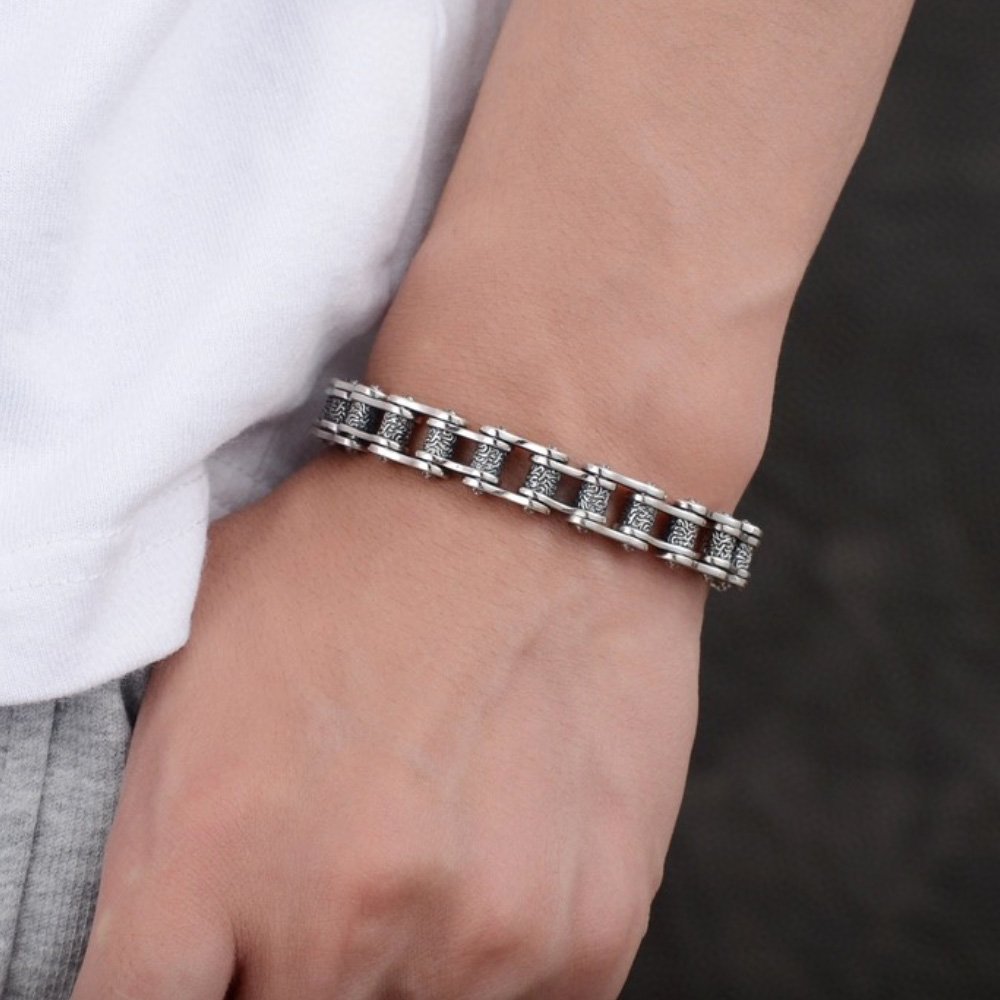
Buying a Men’s Silver Bracelet as a Gift When You Don’t Know His Wrist Size
You Found the Right Bracelet—But What Size Do You Order?
You’ve found a men’s silver bracelet that looks exactly like something he would wear. There’s just one problem: the size options are 7.5, 8, 8.5, and 9 inches, and you have no idea which one to choose. Asking him to measure his wrist would pretty much ruin the surprise.
Guessing from his height or build isn’t much better. Two men of similar size can have quite different wrist measurements, and even knowing his wrist size doesn’t automatically tell you which bracelet length will fit comfortably.
Fortunately, you don’t need to turn gift shopping into a measuring operation. There are a few ways to get a useful size estimate without asking him directly, and if you still can’t pin it down, you can choose a bracelet that gives you a little more room for error.
First, Look for a Wrist-Size Clue Without Asking Him
If he already owns a bracelet that fits well, start there. Borrow it for a few minutes and measure it from end to end, including the clasp. Also notice how he wears it. Some men like a bracelet fairly close to the wrist, while others prefer enough room for it to move around a little.
Try to compare like with like. If his existing bracelet is a thin, flexible chain and you’re buying a thick silver bracelet for men, copying the length exactly may not give you the same fit. Width and construction make a difference, which we’ll come back to later.
A watch can provide another clue. With a traditional buckle strap, look at which hole he normally uses. You can buckle it at that setting and measure around the inside of the strap. It won’t give you a bracelet size directly, but it can get you much closer to his actual wrist circumference.
And sometimes the easiest solution is simply asking someone else. His partner, a family member, or a close friend may know his wrist size—or be able to find out without making the question suspicious.
What I wouldn’t rely on too heavily is body size. A man who is 6’2″ and 220 pounds probably has a larger wrist than a man who is 5’6″ and 140 pounds, but there are plenty of exceptions. Height, weight, shirt size, and general build can help you rule out an obviously small or large bracelet, but they aren’t precise enough to choose between two close sizes.
If You Still Don’t Know, Choose a Bracelet With More Sizing Forgiveness
Sometimes there simply isn’t a good way to get his wrist measurement. In that case, the style of bracelet you choose can reduce the risk of getting the size wrong.
An open cuff is usually the most forgiving option. Many solid silver cuffs can be adjusted slightly for a closer or looser fit, so you don’t have to hit one exact measurement. That doesn’t mean repeatedly bending the bracelet on and off—the idea is to make a small adjustment for his wrist and then leave it there.
Chain bracelets require a little more accuracy. If you’re choosing one, look for a design offered in several lengths instead of a single standard size. It can also help to compare men’s silver bracelets in different styles and sizes before settling on a design. You’ll quickly see that some bracelets give you more sizing choices than others.
If you’re stuck between two chain bracelet sizes, a slightly relaxed fit usually gives you more margin than a tight one. But don’t automatically choose the largest size “just to be safe.” A bracelet that hangs too far down the hand can be uncomfortable and, depending on the clasp and the wearer’s hand size, may be easier to lose.
At this stage, you’re not trying to guess his wrist to the nearest quarter inch. You’re choosing a design and size that still have a reasonable chance of fitting comfortably even if your estimate is a little off.
Bracelet Width Changes the Fit More Than Most Gift Buyers Expect
An 8-inch bracelet does not necessarily give you 8 inches of usable space around the wrist. This is where bracelet sizing gets a little confusing.
Take two bracelets with the same listed length. One is a relatively flat 5mm chain; the other is a thick, heavy link bracelet. The second one has to curve around the wrist with much more metal on the inside of that curve, so its actual inner circumference can be noticeably smaller. The two bracelets may say “8 inches” on the product page but fit very differently.
Width is often a useful warning sign because wider men’s bracelets tend to be thicker as well, but thickness is really what affects the inside fit. Link construction matters too. A flexible chain that bends freely around the wrist behaves differently from large, rigid links that can only articulate so far.
This is why the familiar advice to “measure the wrist and add half an inch” isn’t a universal formula. It may work well for one men’s silver bracelet and leave another uncomfortably tight.
If you have an estimated wrist measurement, the most useful question to ask the seller is not simply, “How long is this bracelet?” Ask what wrist size that particular bracelet is intended to fit. That accounts for the construction of the actual piece.
Some specialist sellers, including Jewelry1000, can provide recommended wrist sizes for individual bracelet designs rather than relying on overall length alone.
That extra check is especially worthwhile with a wide, substantial bracelet. If you’re already working with an estimated wrist size rather than an exact one, you don’t want a second guess—how the listed bracelet length translates into actual fit—stacked on top of the first.
Before You Guess a Size, Give Yourself an Exit Plan
Even after doing all of this, you may still have to make an educated guess. That’s fine. Just make sure a wrong guess is easy to fix.
Check the return and exchange policy before ordering, particularly the time limit and whether a bracelet can be exchanged for another length. Keep the packaging until he has tried it on, and avoid engraving or other personalization if you’re not confident about the size. Customized jewelry is often harder—or sometimes impossible—to return.
If you’re deciding between two sizes, it can also be worth asking the seller. Give them the estimated wrist measurement, the bracelet you’re considering, and how you think he would prefer it to fit. Someone familiar with that particular design may know that an 8-inch version runs snug while another style of the same length has more room.
This matters even more if the bracelet is for a birthday, anniversary, or other fixed date. Leave enough time for an exchange rather than ordering at the last minute and hoping the fit works.
Men’s silver bracelets are often bought as gifts, so not knowing the exact wrist size isn’t an unusual problem. You don’t need to eliminate every bit of uncertainty. You just want to avoid a situation where being half an inch off turns a good gift into something he can’t comfortably wear.
Keep the Surprise, Reduce the Guesswork
You don’t need an exact wrist measurement to give a bracelet as a surprise. If he already wears one, that’s your best reference. If not, a watch, a little help from someone close to him, or even a rough estimate can narrow down the choices.
From there, give yourself some margin. Choose a design with sensible size options, remember that a thick bracelet may fit tighter than its stated length suggests, and check what wrist size the seller actually recommends for that particular piece.
And if your detective work still leaves some uncertainty, make sure exchanging the bracelet for another size is straightforward. The goal isn’t to somehow guess his wrist size perfectly. It’s to make a well-informed choice—and make sure a small sizing mistake doesn’t spoil an otherwise great gift.