
Why clean beauty is the next hormone revolution
Written by Stephi LaReine — Lifestyle Writer
Skincare has always been marketed as surface-level — fix the spots, soften the lines, glow like you’ve had 10 hours of sleep. But here’s the truth: what you put on your skin doesn’t just sit there. It seeps. It speaks. It whispers to your hormones.
For women, that means skincare can either support our estrogen balance — or silently sabotage it. And the worst part? Most of us never even knew.
Endocrine-disrupting chemicals (EDCs) are hidden in everyday products. Parabens, phthalates, oxybenzone, synthetic fragrances — all designed to make our creams, serums, and lipsticks “better,” but often at the cost of our hormones. Studies show these chemicals can mimic estrogen, interfere with fertility, worsen acne, trigger PCOS symptoms, and accelerate early menopause (Endocrine Society, 2020; NIH, 2019).
This isn’t fear-mongering. It’s fact. And in 2025, estrogen-safe skincare isn’t just a trend — it’s the new clean beauty standard.
How Did We Get Here? (A Short History of Hormone-Disrupting Beauty)
- 1950s–60s: Parabens were introduced as cheap preservatives. They extended shelf life, but no one asked what they did to the body.
- 1980s–90s: Synthetic fragrances boomed. Brands added phthalates to make scents last longer — without telling consumers.
- 2000s: The Campaign for Safe Cosmetics began spotlighting endocrine disruptors, forcing research into mainstream.
- Today: The EU bans 1,300+ chemicals in cosmetics. The US? Only 11 (EU Commission, 2024; FDA, 2019).
Regulation still lags, especially in the UK post-Brexit. Which means: the burden falls on us to choose wisely.
Why Hormone-Safe Skincare Matters
The skin is our largest organ, absorbing around 60% of what we put on it (Journal of Applied Toxicology, 2019). That serum that smells “fresh”? It may contain phthalates that mimic estrogen. That “hydrating” lotion with parabens? Studies show parabens bind to estrogen receptors, contributing to hormone-sensitive conditions (Darbre, 2006).
Endocrine disruptors (EDCs) are chemicals that interfere with hormonal systems. For women, the effects can look like:
- Worsened PMS, acne, bloating
- Irregular cycles or heavier periods
- Fertility struggles
- Higher risk of breast cancer (linked with long-term paraben exposure)
- Exacerbation of PCOS and endometriosis symptoms (Endocrine Reviews, 2019)
The Science of Estrogen & Skin Health
Estrogen isn’t just about fertility — it’s a skin hormone. It stimulates collagen, keeps elasticity, supports hydration, and even helps wound healing (British Journal of Dermatology, 2014).
When estrogen dips (during PMS, perimenopause, menopause), women often notice:
- Drier skin
- Loss of glow
- Increased fine lines
- Slower healing
So why sabotage the estrogen we do have with disruptors in skincare? Choosing estrogen-safe products isn’t about fear — it’s about respecting the hormone that keeps our skin resilient.
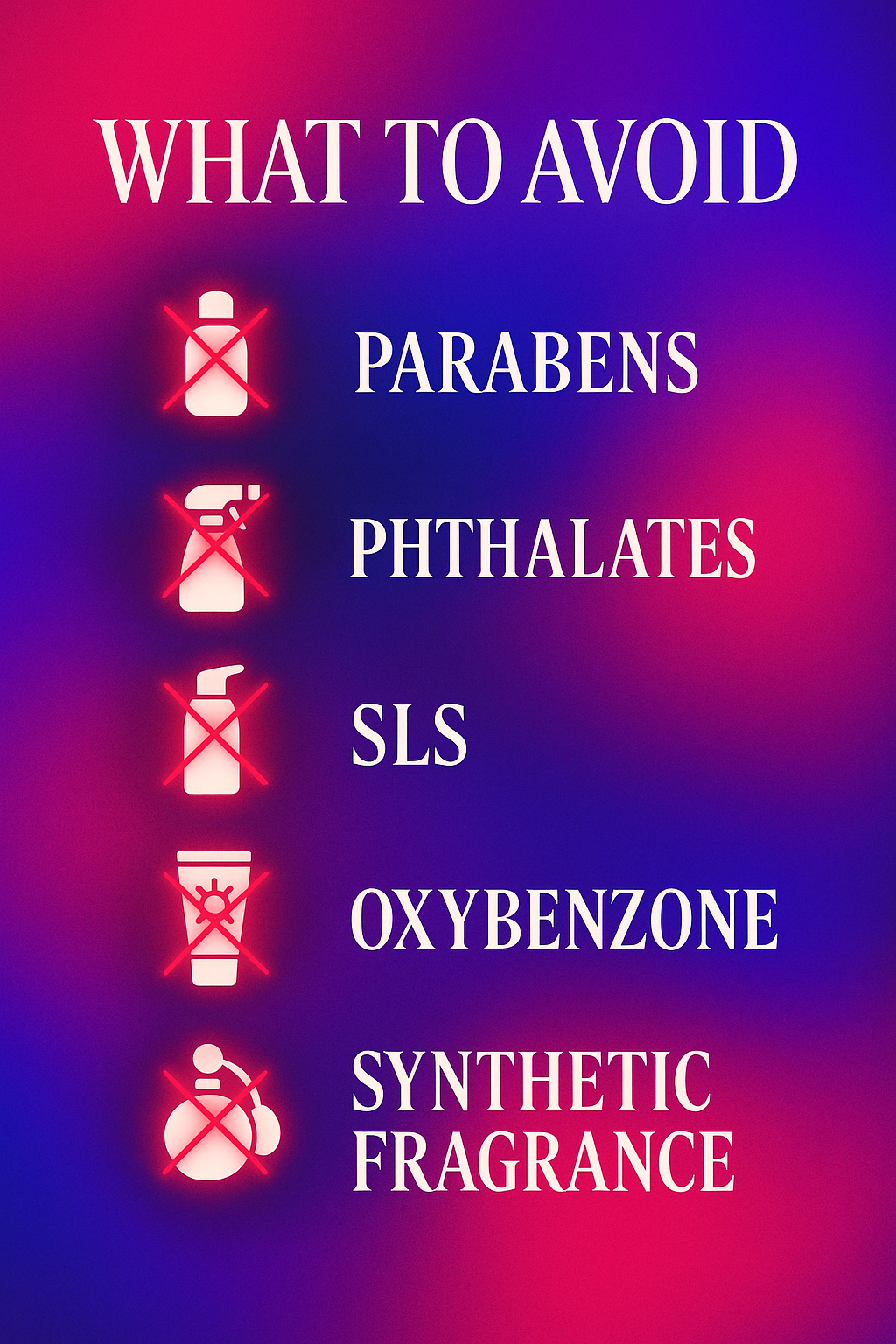
Ingredients to Avoid (Backed by Science)
Here’s the blocklist every woman needs to know:
- Parabens — Used as preservatives. Mimic estrogen, found in breast tissue (Darbre, 2006).
- Phthalates — Often hidden in “fragrance.” Linked to reduced fertility, hormone disruption (Harley et al., 2016).
- SLS/SLES — Harsh surfactants that damage the skin barrier, making it easier for toxins to enter (Journal of the American College of Toxicology, 1983).
- Synthetic Fragrance — A cocktail of chemicals, often containing phthalates. Look for “parfum” on labels.
- Oxybenzone (Benzophenone-3) — Common sunscreen ingredient, linked to endocrine disruption and fertility effects (FDA, 2019).
PCOS, Endometriosis & Acne: Why It Matters Even More
- PCOS: Already involves higher androgens, disrupted estrogen. EDCs push balance further off, worsening symptoms (Fertil Steril, 2017).
- Endometriosis: Estrogen-dependent disease, worsened by environmental estrogens (Reprod Biol Endocrinol, 2014).
- Acne: Hormone-driven condition. Studies link synthetic fragrance + phthalates to increased skin flare-ups.
For women with these conditions, estrogen-safe skincare isn’t optional. It’s essential.
How to Check if Your Skincare is Estrogen-Safe
- Scan Labels: Watch for parabens, phthalates, benzophenone, oxybenzone.
- Apps: Think Dirty or EWG’s Skin Deep to scan barcodes.
- Look for Certifications: COSMOS, Ecocert, Soil Association.
- “Fragrance-Free” vs “Unscented”: Only fragrance-free means no phthalates. Unscented may still contain masking agents.
The Best Estrogen-Safe Skincare Products in 2025
I’ve curated my routine with clean, hormone-friendly picks that actually work:
- Cleanser: Typology Purifying Cleansing Bar – fragrance-free, no parabens.
- Serum: The Ordinary Niacinamide 10% + Zinc 1% – regulates oil + acne without hormones.
- Moisturiser: Paula’s Choice Omega+ Complex – rich in omegas, no parabens or phthalates.
- SPF: REN Clean Screen Mineral SPF 30 – zinc oxide mineral sunscreen, no oxybenzone.
- Extras: Cold-pressed rosehip oil, pure aloe gel for hydration, magnesium cream before bed.
My Hormone-Friendly Skincare Ritual
- Morning: Gentle cleanse, niacinamide serum, omega moisturiser, mineral SPF.
- Evening: Double cleanse, rosehip oil, aloe gel, magnesium cream on neck/shoulders.
- Weekly: Clay mask + red light therapy session.
It’s minimal, it’s effective, and it respects my hormones while keeping my skin glowing.
Clean Beauty Meets Longevity
Longevity isn’t just about supplements and saunas — it’s in our skincare too. The same way I add collagen to my cacao, I strip parabens from my cleansers. The beauty industry is finally catching up: consumers are demanding products that are safe for skin and hormones.
By 2026, “estrogen-safe” will be the new “clean beauty.” Brands that ignore this shift won’t survive.
Science Spotlight: Quick Facts
- Parabens were found in 99% of breast tissue samples in a UK study (Darbre, 2004).
- Mineral sunscreens with zinc oxide block UV without mimicking estrogen (Journal of Photochemistry, 2019).
- Pregnant people exposed to phthalates show higher risk of developmental issues in children (Environmental Research, 2018).
FAQ
It’s skincare free from endocrine-disrupting chemicals that mimic or interfere with estrogen.
Yes. Chemicals like parabens and phthalates are absorbed through the skin and measurable in blood/urine.
Not always. Natural ≠ safe. Essential oils can be irritating; some botanicals act hormonally. Always check.
Yes. Phthalates and parabens are linked to reduced sperm quality. Hormone-safe skincare is universal.
It can’t cure, but reducing xenoestrogen exposure helps lighten the load on the endocrine system.
References
- Darbre PD. Environmental oestrogens, cosmetics and breast cancer. Best Pract Res Clin Endocrinol Metab. 2006.
- Darbre PD. Concentrations of parabens in human breast tumours. J Appl Toxicol. 2004.
- Endocrine Society. Endocrine-Disrupting Chemicals. 2020.
- Harley KG et al. Prenatal and early childhood exposure to phthalates. Environ Health Perspect. 2016.
- British Journal of Dermatology. Estrogen and skin ageing. 2014.
- Reprod Biol Endocrinol. Environmental factors and endometriosis. 2014.
- Fertil Steril. PCOS and endocrine-disrupting chemicals. 2017.
- FDA. Sunscreen: How to Help Protect Your Skin. 2019.
- Environmental Research. Prenatal phthalate exposure. 2018.
- Journal of Photochemistry. Mineral sunscreen safety. 2019.
Suggested Reading:
Best Biohacking Tools for Women in 2025 (Tested + Approved)
The Hormone-Balancing Diet Plan for Women With ADHD (2025 Guide)
Modern Hormone Crisis: Why Imbalances Are the New Normal
The Hormone-Balancing Diet Plan for Women With ADHD (2025 Guide)